
There is nothing quite like the thrill of the roulette wheel. Whether you are playing at a luxury casino in Goa or spinning the wheel on a live dealer app from your smartphone, watching the little white ball bounce across the pockets is pure excitement.
But once the initial thrill wears off, a common question naturally arises: what is the most successful roulette strategy?
If you are looking for a magical formula that guarantees you will beat the casino every single time, we have a reality check for you: it doesn’t exist. Roulette is fundamentally a game of chance. However, if you want to understand how to manage your bankroll, extend your playtime, and maximize your chances of walking away with a profit during a hot streak, you are in the right place.
Let’s break down the math, the myths, and the most popular betting systems used by players today.
The Mathematics: Understanding the House Edge
Before diving into any betting strategy, you need to understand who you are playing against: the house edge.
Every bet you place on a roulette table has a slightly negative expected value. This happens because the payouts the casino gives you do not perfectly match the true mathematical odds of you winning.
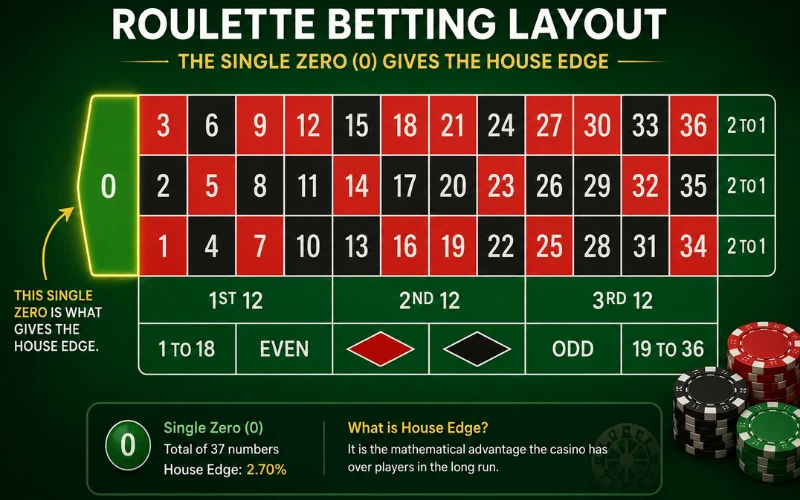
Where does this edge come from? The green zero. Whenever the ball lands on zero, all standard “even-money” outside bets (like Red/Black or Odd/Even) automatically lose.
European vs. American Roulette
The most important strategy you will ever use happens before you even place a bet: choosing the right table.
- European Roulette: This wheel has 37 pockets (numbers 1-36, plus a single 0). The house edge here is a manageable 2.7%.
- American Roulette: This wheel has 38 pockets because it adds a double-zero (00). That single extra pocket nearly doubles the house edge to a brutal 5.26%.

The golden rule for Indian players: Always seek out European roulette tables. There is simply no mathematical reason to play American roulette when European options are available.
What is the Most Successful Roulette Strategy? Top Systems Explained
While you cannot change the built-in math of the wheel, you can change how you bet. Betting systems are structured ways to manage your money based on whether you won or lost the previous spin.
Here are the three most popular systems, broken down by their risk levels.
1. The Martingale System (High Risk)
The Martingale is the most famous betting system in the world. It relies on a very simple premise: double your bet after every loss.
- How it works: You place an even-money bet (e.g., ₹100 on Red). If you lose, you bet ₹200 on Red. If you lose again, you bet ₹400. When you finally win, you will recover all of your previous losses, plus a profit equal to your original ₹100 base bet. After a win, you reset back to ₹100.
- The flaw: The Martingale assumes you have an infinite bankroll and that the casino has no betting limits. In reality, a harsh losing streak of 7 or 8 spins can force you to bet massive amounts of rupees just to win back your original ₹100. Eventually, you will either run out of cash or hit the table’s maximum bet limit.
2. The Paroli System (Medium Risk)
Often called the “Reverse Martingale,” the Paroli system is designed for players who want to capitalize on lucky winning streaks without risking huge amounts of their own money.
- How it works: Instead of doubling after a loss, you double your bet after a win. If you bet ₹100 and win, your next bet is ₹200. If that wins, you bet ₹400.
- The safety net: The rule of Paroli is that you stop and reset to your base bet after three consecutive wins. If you lose at any point, you also reset to your ₹100 base bet.
- The benefit: You are mostly risking the casino’s money during a hot streak, and your losses during a cold streak are strictly limited to your small base bet.
3. The D’Alembert System (Low Risk)
If the Martingale is too stressful and the Paroli feels too aggressive, the D’Alembert system offers a slow, steady, and conservative approach.
- How it works: You choose a base unit (e.g., ₹100). If you lose, you increase your next bet by exactly one unit (bet ₹200). If you win, you decrease your bet by one unit (down to ₹100).
- The benefit: This system assumes that over a long session, your wins and losses will roughly even out. It protects your bankroll from wild swings, ensuring you can play for a longer time without taking massive financial hits.
Practical Tips for Managing Your Bankroll
Ultimately, the best strategy is excellent money management. Keep these tips in mind before your next session.
Setting Limits in INR
Before you log into an online casino or step onto the gaming floor, decide exactly how much money you are willing to lose. If your entertainment budget for the night is ₹5,000, consider that money spent. If you lose it, walk away.
Equally important is setting a “win goal.” If you double your money to ₹10,000, have the discipline to cash out and enjoy your profits.
Sticking to Outside Bets
Betting systems like the Martingale or Paroli are completely mathematically useless if you are betting on single numbers (inside bets). These strategies require a near 50/50 chance to function. Always stick to the “Outside Bets”:
- Red or Black
- Odd or Even
- High (19-36) or Low (1-18)
Frequently Asked Questions (FAQs)
Does the Martingale strategy actually work in the long run?
No. The Martingale works very well in the short term, but it is mathematically guaranteed to fail in the long run. A prolonged losing streak will eventually wipe out your bankroll or force you to hit the casino’s maximum table limit, preventing you from doubling your bet.
Is online live roulette rigged?
As long as you are playing at a fully licensed, regulated, and reputable online casino, live dealer roulette is not rigged. These games use real physical wheels, are monitored by multiple cameras, and undergo strict audits by independent gaming commissions to ensure fairness.
Which is better: inside bets or outside bets?
It depends on your goal. Inside bets (betting on specific numbers) offer massive payouts (35 to 1) but have a very low probability of hitting. Outside bets (Red/Black) offer low payouts (1 to 1) but hit almost half the time. For steady play and bankroll management, outside bets are vastly superior.