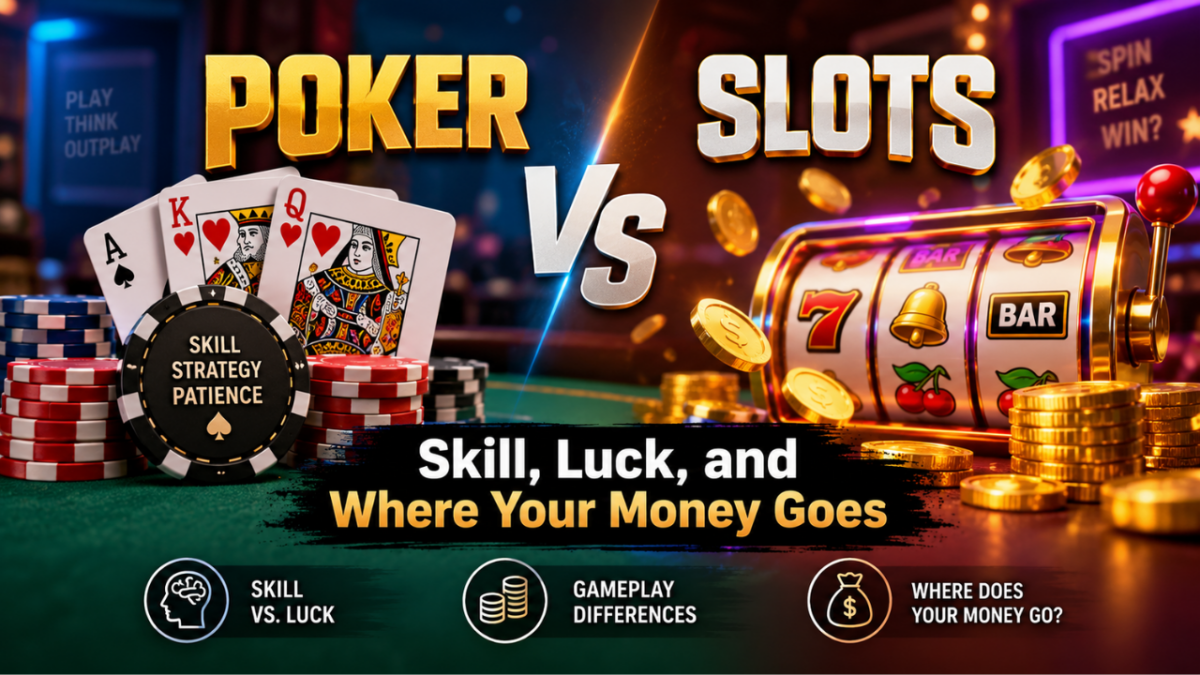
Poker and slot machines are two of the most recognizable casino games, but they offer very different experiences. Poker combines decision-making, strategy, psychology, and chance, while slots are primarily chance-based games designed around simple gameplay and random outcomes.
Understanding the differences between poker vs. slots can help players make informed choices about how each game works, what influences results, and how quickly money can be spent.
Poker vs. Slots: What’s the Difference?
Sabse bada farq player ke role ka hota hai.
Poker mein, aapke decisions game ke outcome ko badal sakte hain. Players apne cards, betting situation aur apne opponents ko analyze karke decide karte hain ki unhe bet, call, raise, check, ya fold karna hai.
Slots bilkul alag tarah se kaam karte hain. Ek baar aapne apna bet select kiya aur reels ko spin kar diya, toh result puri tarah game ke Random Number Generator (RNG) system par depend karta hai. Spin hone ke baad aap aisa koi decision nahi le sakte jo result ko change kar de.
| Feature | Poker | Slots |
|---|---|---|
| Main factor | Skill + chance | Chance |
| Player decisions | High | Very limited |
| Opponents | Usually other players | Usually the casino/game |
| Game speed | Depends on table | Usually fast |
| Strategy | Important | Limited |
| Outcome | Cards + decisions | Random outcome |
| Bankroll management | Important | Important |
How Much Skill Does Poker Require?
Poker, khaskar Texas Hold’em jaise formats mein, ek tagdi strategy ki zaroorat hoti hai. Players ko kafi cheezon par dhyan dena padta hai:
- Starting-hand ki strength
- Table par aapki position
- Pot odds
- Betting patterns aur probability
- Opponents ka behavior aur bluffing
Ek strong poker player bhi har haath (hand) jeetne ki guarantee nahi de sakta. Kabhi-kabhi weaker hand jeet jata hai, aur experienced players bhi kismat (variance) ki wajah se haar sakte hain. Par lambe samay (long-term) mein, achhi decision-making aur strategy ka aapke results par bahut bada asar hota hai. Poker purely skill ka game nahi hai; cards randomly deal hote hain, isliye achhe players har hand jeetne ki jagah hamesha sahi decision lene par focus karte hain.
Poker Isn’t Purely a Game of Skill
It’s important not to confuse skill with guaranteed profit.
Cards are still dealt randomly. Even when a player makes what appears to be the mathematically stronger decision, the result of an individual hand can go against them.
This is why experienced poker players generally focus on making good decisions repeatedly rather than expecting to win every hand.
How Much Skill Do Slots Require?
Slots fundamentally bilkul alag hain. Modern aur online slots purely random number generation par chalte hain. Aap sirf yeh choose kar sakte hain:
- Bet ka size kya hoga
- Kitni paylines ya features active rakhne hain
- Kab spin karna hai aur kab rukna hai
Lekin ye choices aapko kisi bhi individual spin ka result control ya predict karne ki taqat nahi deti. Agar koi strategy claim karti hai ki ek specific time ya betting pattern se aap slots jeet sakte hain, toh aisi baaton se bach kar rahna chahiye.
Luck in Poker vs. Slots
Both games involve luck, but its role is different.
Poker
Luck can have a major impact on individual hands. A player can receive strong cards, lose with them, or win with an unexpected combination.
Over many hands, however, skill can influence long-term performance.
Slots
Luck is the central factor in determining individual results. Each spin is generally independent, meaning previous results do not create a reliable prediction about what will happen on the next spin.
For example, if a slot has produced several losing spins, that does not mean a winning spin is necessarily “due.”
Where Does Your Money Go?
This is one of the most important differences between poker and slots.
Where Money Goes in Poker
In a typical cash poker game, players compete against each other. The casino or poker platform generally earns money through a rake or other fees rather than directly taking the entire difference between winning and losing players.
For example, if several players contribute money to pots, the winning player receives the pot, subject to the game’s rules and applicable fees.
This means your financial results can depend heavily on the decisions and skill levels of the other players at the table.
Where Money Goes in Slots
Slots are generally designed with a mathematical advantage for the casino or game operator.
A slot’s return to player (RTP) represents the theoretical percentage of wagers returned to players over a very large number of plays.
For example, a hypothetical slot with a 96% RTP would theoretically return about $96 for every $100 wagered over an extremely large sample of spins. It does not mean that an individual player will receive exactly $96 after wagering $100.
The remaining theoretical percentage represents the game’s house edge.
RTP vs. Poker Rake
These concepts are useful but shouldn’t be treated as identical.
Slots: RTP describes the game’s theoretical long-term return to players.
Poker: The operator generally earns through fees such as rake, while players compete against one another.
This creates a fundamental difference in how the games transfer money between participants and the operator.
Which Game Is Faster?
Slots are generally much faster.
A player can make multiple spins within a short period, particularly on online platforms. This means money can be wagered quickly.
Poker usually moves more slowly because players have to make decisions and wait for other players.
However, fast gameplay can also mean faster spending. A player who wants to control their gambling budget should consider the speed at which bets are being placed, not just the size of each individual wager.
Poker vs. Slots: Understanding Variance
Variance describes how widely short-term results can fluctuate.
Poker can involve substantial variance. A skilled player can experience losing sessions, even when making sound decisions.
Slots can also have different volatility levels. Some games may offer frequent smaller wins, while others may produce less frequent but potentially larger payouts.
High volatility does not mean a game is more profitable. It describes the distribution and frequency of potential outcomes.
Can You Make Money Playing Poker or Slots?
Neither game should be treated as a guaranteed way to make money.
A skilled poker player may have an advantage over other players over the long term, but results can fluctuate substantially and expenses, rake, and variance matter.
Slots are primarily chance-based, and the mathematical design of the game generally gives the house an advantage over the long run.
For recreational players, the more useful approach is to treat gambling as entertainment rather than as a dependable source of income.
Bankroll Management Matters for Both
Regardless of whether you prefer poker or slots, setting financial limits can help keep gambling within a predetermined entertainment budget.
Consider:
- Setting a maximum gambling budget before playing
- Never using money needed for rent, bills, or essential expenses
- Avoiding attempts to recover losses by increasing bets
- Taking breaks during longer sessions
- Setting time limits as well as spending limits
- Stopping when your predetermined budget has been reached
A particularly important principle is not chasing losses. Losing money does not create an obligation to continue playing until it is recovered.
Poker vs. Slots: Which Experience Is Different?
The choice ultimately depends on what type of gaming experience someone is looking for.
Poker offers more interaction and decision-making. Players who enjoy probability, strategy, competition, and reading situations may find poker more engaging.
Slots offer a simpler experience. Players generally select their wager, spin the reels, and wait for the outcome. There is little strategic decision-making during an individual spin.
Neither format eliminates risk, and neither guarantees a profit.