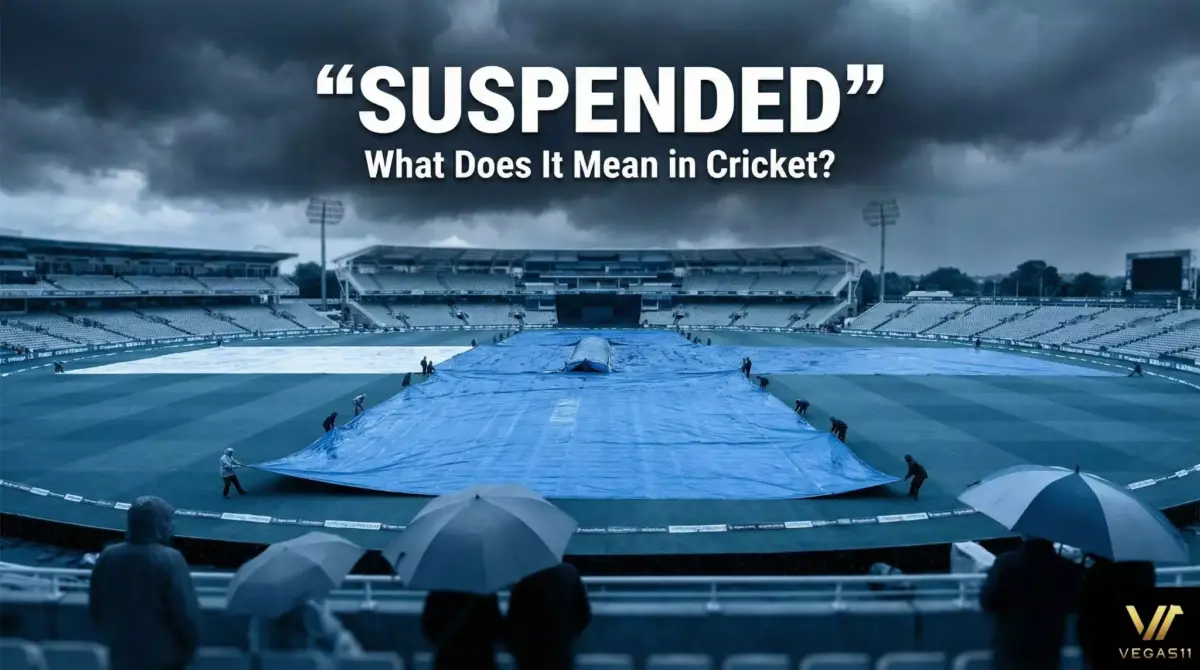
Cricket, as an outdoor sport, is often affected by external conditions such as weather or safety issues. In these situations, understanding the suspended meaning in cricket is key: a “match suspended” decision refers to a temporary halt in play, not the end of the game. Unlike abandonment, a suspension indicates that play is expected to resume once conditions are safe and fair again.
What Does “Suspended” Mean in Cricket?
In cricket, the word “suspended” is used in more than one context, which often leads to confusion among casual viewers and even seasoned fans. To fully understand the suspended meaning in cricket, it is essential to recognize that the term can apply either to a match situation or to a disciplinary action involving a player or team.
On one hand, “suspended” may describe a match that has been temporarily halted due to external or unsafe conditions. On the other, it can refer to a formal punishment that prevents a player—or in rare cases, an entire team—from participating in future fixtures. The correct interpretation depends entirely on context.
Because this dual usage frequently appears in live commentary, scorecards, tournament updates, and news headlines, knowing which form of suspension is being referenced is critical to understanding what is actually happening in the game.
Match Suspension vs. Player Suspension
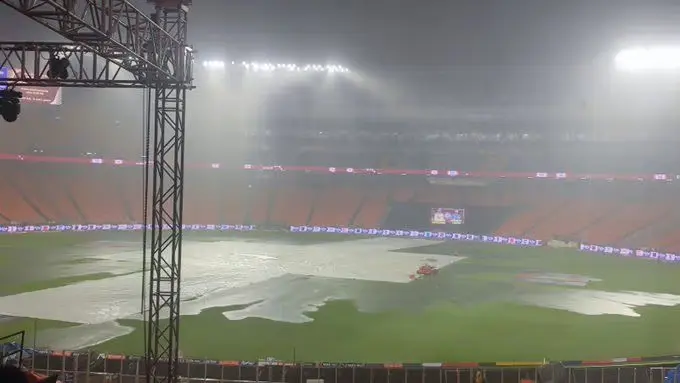
When a cricket match is described as “suspended,” it generally means that play has been temporarily stopped by the on-field umpires. This decision is usually triggered by conditions that make continuation unsafe or unfair—such as rain, lightning, deteriorating light, or technical issues. Importantly, a suspended match is not concluded; it remains paused, with the intention of resuming once conditions allow.
By contrast, when a player is suspended, the term carries an entirely different meaning. In this scenario, suspension refers to a disciplinary ban, typically imposed for breaching the ICC’s Code of Conduct or a domestic league’s regulations. Common offences include slow over-rate violations, dissent toward officials, excessive on-field misconduct, or repeated breaches of playing conditions. A suspended player is barred from selection for one or more matches, depending on the severity of the offence.
For fans following live coverage—or bettors monitoring in-play markets—distinguishing between these two forms is essential. A suspended match may still reach a result later, while a suspended player is definitively unavailable for selection.
Reasons Why a Cricket Match Gets Suspended
Weather Conditions
Weather-related issues are the most common cause of match suspension in cricket. Rain is the primary factor, but lightning presents a more serious safety concern. As per widely accepted safety protocols, play cannot resume until at least 30 minutes have passed since the last lightning strike in the vicinity of the ground.
“Bad light” is another frequent cause, particularly in longer formats. When natural light drops to a level where batters can no longer safely pick up deliveries—especially from fast bowlers—umpires may suspend play even if floodlights are operational. To ensure objectivity, umpires use light meters to assess whether visibility meets acceptable safety standards.
Unsafe Pitch or Ground Conditions
Even after rain has stopped, a match may remain suspended if the pitch or outfield is deemed unsafe. Wet or slippery surfaces increase the risk of injury to fielders attempting dives or slides. Additionally, a damp ball becomes difficult for bowlers to grip, potentially skewing the balance between bat and ball.
Umpires conduct repeated inspections of both the pitch and outfield, and play is only permitted to resume once conditions are considered safe and fair.
Technical Issues
In modern cricket, technological and infrastructural failures can also lead to suspension. Day-night matches have been interrupted due to floodlight malfunctions or power outages affecting the stadium. In some cases, failures involving key systems—such as the Decision Review System (DRS), stump microphones, or broadcast infrastructure—have resulted in temporary suspensions while officials resolve the issue.
Although relatively uncommon, these incidents still fall under the suspended meaning in cricket, as play is halted by the umpires for operational reasons.
Unusual Interruptions
Cricket history includes several unconventional suspensions caused by unexpected events. Matches in India have been paused due to snakes on the field, stray dogs chasing the ball, or other wildlife intrusions. One of the most notable non-weather-related suspensions occurred during a Test match in New Delhi, when extreme smog and hazardous air quality forced players to wear masks, prompting officials to suspend play on health grounds.
The Rules: What Happens When a Match Is Suspended?
Authority of Umpires and Match Referees
The decision to suspend a match rests solely with the on-field umpires, not the team captains. Umpires may consult the Match Referee, but the final judgment is based on whether conditions are deemed “dangerous or unreasonable.” Once a match is suspended, officials conduct regular inspections to determine if play can safely resume.
Resumption vs. Abandonment
A suspended match is best described as being in a holding state. The primary objective is to resume play on the same day, often by reducing the number of overs. However, if conditions do not improve and time expires, the match may be officially declared “Abandoned.”
In limited-overs cricket, an abandoned match typically results in a “No Result,” with points shared—unless enough overs have been completed to produce a result under revised playing conditions.
The DLS Method (Duckworth–Lewis–Stern)
When overs are lost due to suspension, the Duckworth–Lewis–Stern (DLS) method is used to recalculate targets. This system factors in both remaining overs and wickets in hand, ensuring competitive balance despite interruptions. The DLS method is integral to understanding the suspended meaning in cricket, as it allows rain-affected matches to conclude fairly rather than arbitrarily.
“Suspended” in the Context of the IPL (Indian Premier League)
Cut-off Times and Super Overs
The IPL follows strict operational guidelines when a match is suspended. During league matches, if play cannot resume in time to produce a result, the game ends as a “No Result.” However, knockout fixtures prioritize producing a winner.
In the IPL Final, if the match cannot restart before the designated cut-off time—often close to midnight—the contest moves to a Super Over. If even a Super Over is not possible, the team that finished higher in the league standings is declared champion.
Reserve Days
While reserve days are uncommon during the IPL league phase, they are standard for playoff matches and the Final. If a match is suspended and cannot be completed, it resumes on the reserve day from the exact point of interruption. This approach ensures that results are determined by performance rather than weather disruptions.
Other Uses of “Suspended” in Cricket
Player Suspension (Disciplinary Bans)
Beyond match interruptions, suspension also applies to players penalized for misconduct. Under ICC and IPL regulations, slow over-rate offences are a common cause—recently resulting in a one-match suspension for Delhi Capitals captain Rishabh Pant. Other incidents, such as Harshit Rana’s controversial send-off gesture, illustrate how repeated behavioural breaches can escalate from fines to actual bans.
Betting Market Suspended
In live betting environments, viewers may see the status “Market Suspended.” This does not indicate that the match itself has stopped. Instead, it reflects a temporary pause in betting following a significant in-game event—such as a wicket or boundary—allowing bookmakers to update odds before reopening markets.
Famous Examples of Suspended Matches Involving India
One of the most high-profile suspended matches occurred during the 2019 ICC World Cup semi-final between India and New Zealand. Persistent rain forced play to be halted and carried over to the reserve day, ultimately altering the momentum and outcome of the contest.
Similarly, India–Pakistan encounters in the Asia Cup—often staged during monsoon season—have repeatedly been suspended due to rain, leading to DLS-adjusted targets or reliance on reserve days. These instances demonstrate how suspension protocols directly influence tournament progression and fan experience.