Cricket is more than a sport in India and Australia—it is a way of life. The rivalry between the India national cricket team and the Australian men’s cricket team is one of the most intense in the sport, defined by iconic matches and historic milestones. This timeline highlights the key moments that have shaped this legendary contest.
Head-to-Head Summary (Test, ODI, T20I)
Overall Win/Loss Records
For much of the 20th century, Australia established a commanding advantage in head-to-head encounters, routinely overpowering India in both Test series and ODI competitions. However, the India national cricket team vs Australian men’s cricket team timeline has undergone a dramatic shift in recent decades, with India steadily narrowing—and in some cases overturning—the historical gap.
- Test Matches: Australia retains an overall lead, but India has won the last four consecutive Border-Gavaskar Trophy series (2017, 2018–19, 2020–21, 2022–23).
- ODIs: Australia continues to lead overall, supported by multiple World Cup victories against India.
- T20Is: India holds a clear edge, reflecting its strength and depth in the modern limited-overs era.
Performance on Indian Soil vs Australian Soil
Home conditions have long shaped the narrative of this rivalry. Australia dominated at home throughout the 1990s, using fast, bouncy pitches to dismantle visiting teams. Conversely, India turned its subcontinental conditions into near-impenetrable strongholds—most notably with the emphatic 4–0 whitewash of Australia in the 2012–13 Test series.
The India national cricket team vs Australian men’s cricket team timeline shifted decisively when India achieved the unthinkable: winning back-to-back Test series in Australia in 2018–19 and 2020–21. These victories were defined by resilience, tactical maturity, and historic individual performances.
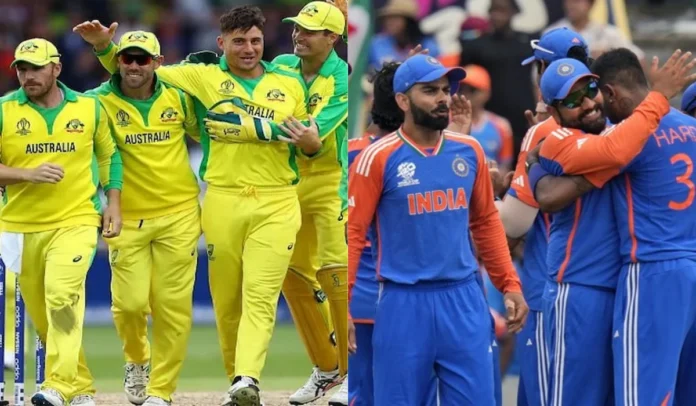
Detailed Timeline: India vs Australia (1947–Present)
1947–1980: Early Encounters and Australian Supremacy
The earliest phase of the India national cricket team vs Australian men’s cricket team timeline was characterized by Australian dominance and India’s gradual adjustment to elite international competition.
- 1947–48: The first Test series between the two nations, held in Australia, ended in a decisive 4–0 victory for the hosts.
- 1969–70: Despite playing at home, India lost the three-Test series 3–1.
- 1977–78: India showed increased competitiveness in Australia, but the hosts edged the five-Test series 3–2.
1980–2000: India’s Emergence and Iconic Moments
This era marked a turning point in the India national cricket team vs Australian men’s cricket team timeline, as India began to challenge Australia more consistently.
- 1980–81: India secured their first-ever Test win in Australia at the MCG, with the series ending 1–1.
- 1986: The Chennai (Madras) Test became only the second tied Test in cricket history.
- 1987: Australia won a five-Test series in India 2–0 under Allan Border.
- 1991–92: Australia whitewashed India 4–0, showcasing the rise of a dominant generation.
- 1996: India defeated Australia in a one-off Test in Delhi, signaling growing home dominance.
- 1999–2000: Australia swept India 3–0, reaffirming their global supremacy.
2000–2010: The Rivalry Peaks
This decade elevated the India national cricket team vs Australian men’s cricket team timeline into one of cricket’s fiercest rivalries.
- 2000–01: India’s historic Kolkata Test victory after following on ended Australia’s 16-Test winning streak and secured a 2–1 series win.
- 2003–04: India earned a hard-fought 1–1 draw in Australia, proving their ability to compete abroad.
- 2007–08: A controversial and emotionally charged series ended 2–1 in Australia’s favor.
2010–Present: Modern Era and Historic Milestones
The modern phase of the India national cricket team vs Australian men’s cricket team timeline is defined by balance, resilience, and landmark achievements.
- 2010–11: India swept Australia 2–0 at home.
- 2012–13: India completed a dominant 4–0 home whitewash.
- 2014–15: Australia won 2–0 at home, though two Tests were drawn.
- 2017: India claimed a 2–1 home series win to retain the Border-Gavaskar Trophy.
- 2018–19: India won their first-ever Test series in Australia (2–1).
- 2020–21: Despite extensive injuries, India produced a historic comeback, winning 2–1 and retaining the trophy after a legendary Gabba victory.
ODI and T20 Clashes: Key Moments
The India national cricket team vs Australian men’s cricket team timeline extends well beyond Test cricket into high-stakes white-ball encounters.
- 1985: India won the World Championship of Cricket in Australia.
- 2007: India defeated Australia in the ICC T20 World Cup semi-final en route to the title.
- 2011: India knocked Australia out in the World Cup quarter-final.
- 2015: Australia defeated India in the World Cup semi-final and went on to lift the trophy.
- 2020: India secured a 2–1 ODI series win in Australia.
Key Player Battles and Records
Top Run Scorers
Batting greats have defined this rivalry. For India, Sunil Gavaskar, Sachin Tendulkar, Rahul Dravid, and Virat Kohli have consistently delivered against Australia. For Australia, legends such as Don Bradman, Allan Border, Ricky Ponting, and Steve Smith have dominated Indian attacks.
Top Wicket Takers
Bowling icons have been equally influential. Kapil Dev, Anil Kumble, and Jasprit Bumrah have produced match-winning spells for India, while Shane Warne, Glenn McGrath, and Brett Lee have tormented Indian batters across generations.
Upcoming Fixtures and Future Timeline
With both teams preparing for upcoming ICC tournaments and new World Test Championship cycles, the rivalry shows no signs of slowing. Long-term bilateral agreements ensure regular encounters, while emerging stars like Shubman Gill, Travis Head, and others continue to raise the competitive bar within the India national cricket team vs Australian men’s cricket team timeline.
Summary: Future ICC events and bilateral series will continue to expand this storied rivalry.
Conclusion
The India national cricket team vs Australian men’s cricket team timeline chronicles cricket’s evolution—from early imbalance to modern-day parity. What once appeared one-sided has transformed into one of the sport’s most compelling narratives, defined by resilience, innovation, and unforgettable moments.
As both nations invest heavily in youth and excellence, the next chapters promise even greater intensity and global significance.