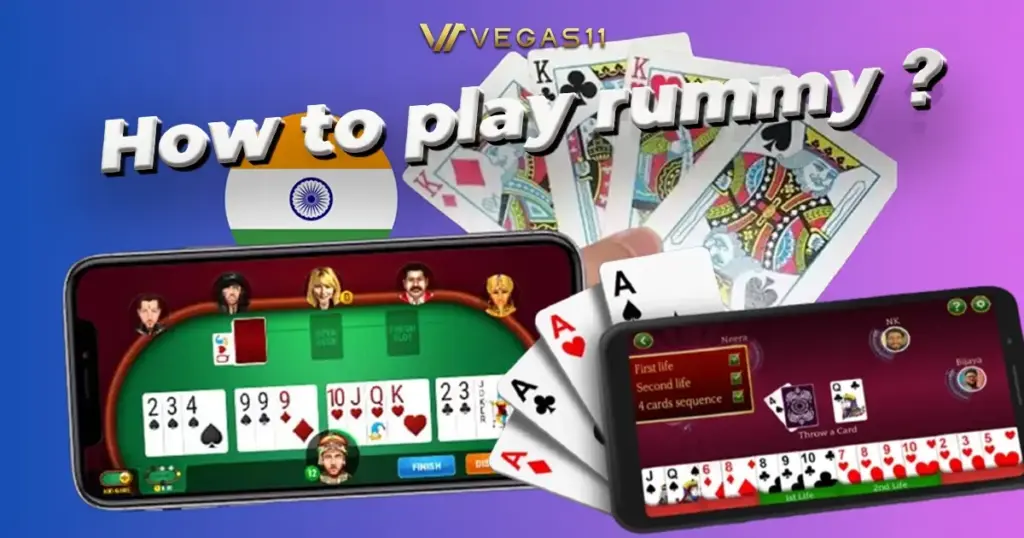
Rummy is widely regarded as India’s most popular card game, enjoyed equally at festive family gatherings and on digital platforms where millions of players participate daily. Unlike games based purely on luck, Rummy combines skill, memory, and strategic thinking, turning every round into a mental contest. Whether played casually or in competitive formats, the true appeal of Rummy lies in reading the game, anticipating moves, and constructing a winning hand before your opponents do.
The objective is straightforward yet highly strategic: arrange all 13 cards in your hand into valid sequences and sets, then make a legal declaration. To win, your total points must be reduced to zero before any other player.
Everything begins with one mandatory rule that cannot be bypassed—you must form at least one Pure Sequence. Understanding this rule is the foundation of mastering Indian Rummy.
How to Play Rummy: Step-by-Step Gameplay
Step 1: Dealing
A toss decides the first dealer. The dealer shuffles both decks and distributes 13 cards to each player. The remaining cards form the closed deck, and the top card is placed face-up to start the discard pile.
Step 2: Picking a Card
On your turn, you must draw one card, either:
- From the closed deck, or
- From the top of the discard pile, if it benefits your hand
Step 3: Discarding
After drawing, you must discard one card to maintain a 13-card hand. Discarding requires careful thought—never offer opponents a card that could complete their combinations.
Step 4: Arranging Cards
Throughout the game, continuously organize your hand into possible Pure Sequences, Impure Sequences, and Sets. Online platforms may offer automatic sorting, but in live play this must be done manually.
Step 5: Declaration (Show)
Once all 13 cards are arranged into valid combinations, discard your final card into the Finish Slot and declare “Show.” Your hand is then checked for validity.
The Setup: Deck and Players
Indian Rummy is typically played by 2 to 6 players seated around a table. The game uses two standard 52-card decks, along with the printed Joker cards included in each deck. This creates a total of 106 cards (52 × 2 + 2 Jokers), ensuring sufficient card availability for forming multiple combinations.
Card Values for Scoring
- Face cards (A, K, Q, J): 10 points each
- Number cards (2–10): Face value (e.g., 6 = 6 points)
In Rummy, points represent penalties. The goal is not to score points, but to avoid them—the lower your points, the better your outcome.
Understanding Rummy Terminology
To play smoothly and confidently, it’s essential to understand the key elements of the game layout.
Draw Pile (Closed Deck)
The face-down stack of remaining cards placed at the center of the table. Players draw from here when they want an unknown card.
Discard Pile (Open Deck)
The face-up pile where players place unwanted cards. On your turn, you may choose the top card from this pile if it improves your hand.
The Joker: Your Strategic Advantage
Indian Rummy includes two types of Jokers:
- Printed Joker: The illustrated Joker card included in the deck
- Wild Joker: A randomly selected card at the start of the game
If, for example, 7♥ is chosen as the Wild Joker, then all four 7s—7♠, 7♦, 7♣, and 7♥—function as Jokers.
Jokers can substitute for missing cards in Impure Sequences and Sets, but they are not allowed in a Pure Sequence.
The Drop: A Strategic Exit
If your initial hand is particularly weak, you may choose to Drop and exit the round early. Dropping limits your point loss and prevents you from accumulating a heavy penalty by continuing with poorly arranged cards.
The Core Rules: Sequences and Sets
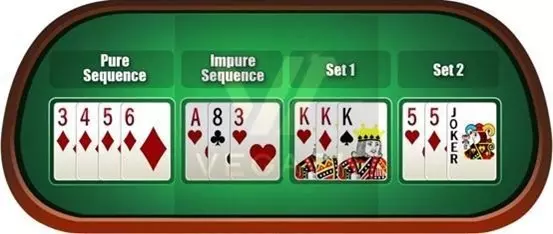
A valid Rummy declaration must include at least two sequences, one of which must be a Pure Sequence.
Pure Sequence (The First Life)
A Pure Sequence consists of three or more consecutive cards of the same suit, formed without using any Joker.
- ✅ Valid: 4♥, 5♥, 6♥
- ❌ Invalid: 4♥, Joker, 6♥
This rule is absolute. Without a Pure Sequence, your declaration is invalid, and you incur the maximum penalty.
Impure Sequence (The Second Life)
An Impure Sequence includes one or more Jokers used to complete a run of consecutive cards of the same suit.
Example:
4♠, Joker, 6♠ (Joker represents 5♠)
Once your Pure Sequence is secured, Impure Sequences help organize the remaining cards efficiently.
Sets (Three or Four of a Kind)
A Set consists of three or four cards of the same rank, each from a different suit.
- ✅ Valid: 7♥, 7♠, 7♦
- ❌ Invalid: 7♥, 7♥, 7♠
Jokers may be used in Sets (e.g., K♣, Joker, K♦), but they do not replace the requirement for a Pure Sequence.
How Points Are Calculated (Scoring)
In Indian Rummy, the winner scores 0 points. All other players receive penalty points based on the value of their ungrouped cards.
- Only cards not part of valid combinations are counted
- Most formats cap the maximum loss per round at 80 points
Wrong Declaration
If a player declares without a Pure Sequence or with invalid groupings, it is considered a Wrong Declaration. The penalty is immediate—80 points, and the round is lost.
5 Pro Tips to Win at Indian Rummy
- Secure the Pure Sequence First
Without it, you cannot declare—everything else is secondary. - Discard High-Value Cards Early
Face cards cost 10 points each. If they aren’t forming combinations early, discard them. - Track Opponent Discards
Observing what others pick and discard reveals their strategy and helps you avoid assisting them. - Use Jokers Strategically
Never waste Jokers on Pure Sequences. Save them for high-value or difficult groupings. - Know When to Drop
If no sequences form early, a First Drop (20 points) is far better than risking an 80-point loss.
Play Rummy Online for Real Money
The online rummy game is available in the chess JILI room of Vegas11 casino.
Vegas11 offers a small betting amount is 1 – 80 rupees, which is suitable for beginners; the maximum betting amount is 20 – 1600 rupees. Friends who have never played before can register to play the game immediately.

The name “rummy” comes from the fact that the first person to complete the deck will shout “Rummy!”