Andar Bahar looks simple — pick a side, watch the cards fall. But behind that simplicity is real math: a calculable edge, a fixed house percentage, and a couple of decisions that actually matter. Here’s how the game really works, and where strategy can (and can’t) help.
What Is Andar Bahar?
One deck. One joker card. Two sides — Andar and Bahar. Players bet on which side will draw a card matching the joker’s rank first.
- Origins: Traced to Karnataka, played for generations in homes and local card circles before going digital.
- Why it’s popular: No hand rankings, no complex bet types, no long learning curve — just a fast, binary call every round.
- The format: Rounds run in seconds to a couple of minutes, which is part of why it’s a favorite on live-dealer platforms.
- The goal: Match the joker’s rank first. That’s the entire game — nothing more to memorize.
Compared to games like teen patti or poker, there’s no bluffing, no positional play, no hand-reading. It’s pure probability, which is exactly why it rewards players who understand the numbers instead of the “feel” of the table.
How Andar Bahar Is Played
- Setup — A single 52-card deck. Dealer shuffles, manages the joker draw, and handles payouts. Live tables replicate this on camera; digital tables use an RNG.
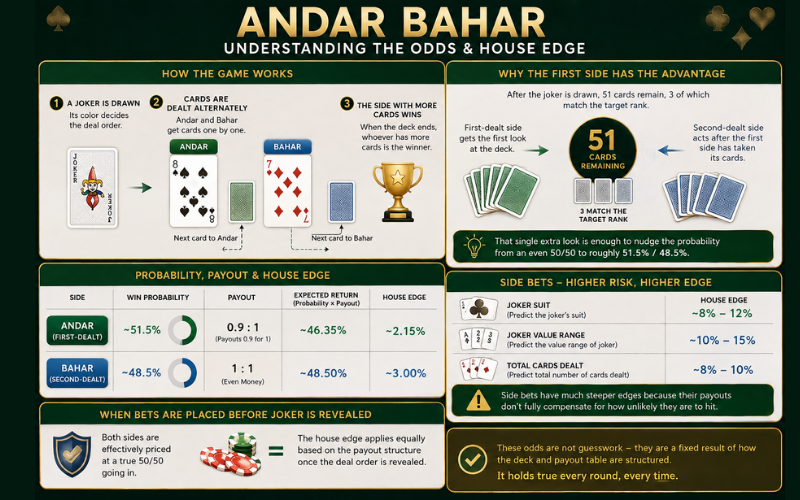
- Joker draw — One card is drawn to set the target rank. Its color usually decides which side gets dealt first: red → Andar, black → Bahar.
- Betting window — Players call Andar or Bahar before the deal resumes, usually within a short timed window.
- The deal — Cards go out one at a time, alternating sides, until the target rank lands. That side wins, and payouts are settled instantly.
- Round reset — The deck is reshuffled (or a fresh RNG draw is made) and a new joker is set for the next round.
A few table variations exist:
- Some platforms reveal the joker’s color before betting closes; others hide it until after bets lock.
- Payout ratios can differ slightly by platform, so it’s worth checking the paytable before playing.
- Some versions offer side bets on the joker’s suit, exact value, or total cards dealt in the round.
Understanding the Odds and House Edge
This is where Andar Bahar gets interesting for anyone who likes numbers, and it’s the part most guides skip.
- The side dealt first wins slightly more often — about 51.5% of the time — simply because it gets first crack at every pass through the deck.
- The side dealt second sits at roughly 48.5%, a small but consistent disadvantage.
- Payouts are structured to offset this: the first-dealt side typically pays 0.9:1, while the second-dealt side pays 1:1 (even money).
- Multiply probability by payout and you land on a house edge of roughly 2.15% on the first-dealt side and roughly 3% on the second-dealt side.
- Side bets — joker suit, joker value range, total cards dealt — carry much steeper edges, sometimes into double digits, because their payouts don’t fully compensate for how unlikely they are to hit.
- Some platforms require bets to be placed before the joker’s color (and therefore the deal order) is revealed. In that format, both sides are effectively priced at a true 50/50 going in, which changes how the edge applies.
None of this is guesswork — it’s a fixed result of how the deck and payout table are structured, and it holds true whether you’re playing your first round or your thousandth.
Why the first side is favored, in plain terms:
- After the joker is drawn, 51 cards remain, three of which match the target rank.
- Because the deal alternates, the first-dealt side gets an extra “look” at the deck before the second side gets its turn.
- That single extra look is enough to nudge the probability from an even 50/50 to roughly 51.5/48.5.
- It’s a small structural quirk of alternating deals, not a flaw or a pattern players can exploit mid-round.
Quick reference:
| Metric | First-Dealt Side | Second-Dealt Side |
|---|---|---|
| Win probability | ~51.5% | ~48.5% |
| Typical payout | 0.9:1 | 1:1 |
| House edge | ~2.15% | ~3% |
Andar Bahar Strategy Tips
Here’s what actually moves the needle — and what doesn’t.
- Set a fixed unit size. Bet 1–2% of your bankroll per round and keep it constant, win or lose. Adjusting bet size based on recent outcomes doesn’t change your odds on the next round.
- Take the first-dealt side when you can see it. If the joker’s color is revealed before betting closes, that side carries the lower house edge (~2.15% vs. ~3%). It’s a small edge, but it’s real and it’s free.
- Skip the side bets unless you’ve checked their exact house edge on that specific platform — the payouts rarely match the actual odds.
- Set a stop-loss and a stop-win before you sit down. Decide both numbers in advance, and treat them as non-negotiable once the session starts.
- Practice on demo tables first. They run on the same probability model with zero financial risk, which makes them a good way to get comfortable with the betting window and deal pace.
- Track your sessions, not individual rounds. Session-level bankroll thinking keeps you focused on the long run instead of reacting to any single hand.
A Simple Session Framework
If you want a repeatable routine rather than deciding fresh each time, this works for most players:
- Before you start: Set total budget, unit size, stop-loss, and stop-win.
- During play: Bet the same unit size every round; favor the first-dealt side when visible; skip side bets.
- After a loss: Do nothing different — stick to the same unit size.
- After a win: Bank part of it mentally as “profit” rather than folding it back into the next bet.
- At your stop-loss or stop-win: Stop. No exceptions, no “one more round.”
Common Mistakes to Avoid
- Chasing “hot” sides. Every round draws from a fresh shuffle (or fresh RNG output). Whatever happened in the last ten rounds has zero statistical bearing on the next one.
- Doubling down after losses. Martingale-style betting — doubling your bet after every loss — doesn’t beat a fixed house edge. It just concentrates more money into bets that still carry the same 2.15%–3% disadvantage.
- Ignoring the paytable. Payout ratios can vary by platform, and a slightly worse paytable can quietly push the house edge higher without the game “feeling” any different.
- Playing past your limits because of momentum. A win streak doesn’t mean the odds have shifted in your favor — the next round’s probability is exactly the same as it was on round one.
- Betting side markets for the payout size alone. A big payout on a side bet usually means a proportionally smaller chance of winning — check the math, not just the number on the button.